If you’ve been following my content recently, you’ve probably heard me talking about the concept of Soft Productivity—this idea that being productive doesn’t have to mean constantly doing more, working harder, or filling every available moment with another task.
And I think this concept is especially important when we apply it to business.
Because there is a very common misconception in business that growth requires you to constantly do more.
If you want more visibility, you need to create more content. If you want more leads, you need to spend more time on social media. If you want more sales, you need to launch more often, send more emails, create more offers, and generally spend more hours working on your business.
But what if the real problem isn’t that you aren’t doing enough?
What if your business simply requires too much active effort from you in order to produce results?
That’s what I want to talk about today, because one of the most important ways that I think we can apply Soft Productivity to our businesses is by creating systems.
Soft Productivity isn’t about lowering your ambitions or caring less about your results. It’s about being more intentional with your time, energy, and attention so that the work you do produces a greater return.
Instead of measuring productivity by how much you accomplish or how many hours you work, you start looking for ways to simplify your workload, prioritize the activities that actually move your business forward, and create systems that reduce the amount of effort required to generate consistent results.
And a good business system gives you a repeatable process for accomplishing an important objective.
Rather than continually asking yourself what you should do next, reinventing your process every time you need to accomplish something, or relying on motivation to keep everything moving, you create a structure that makes important work easier to execute consistently.
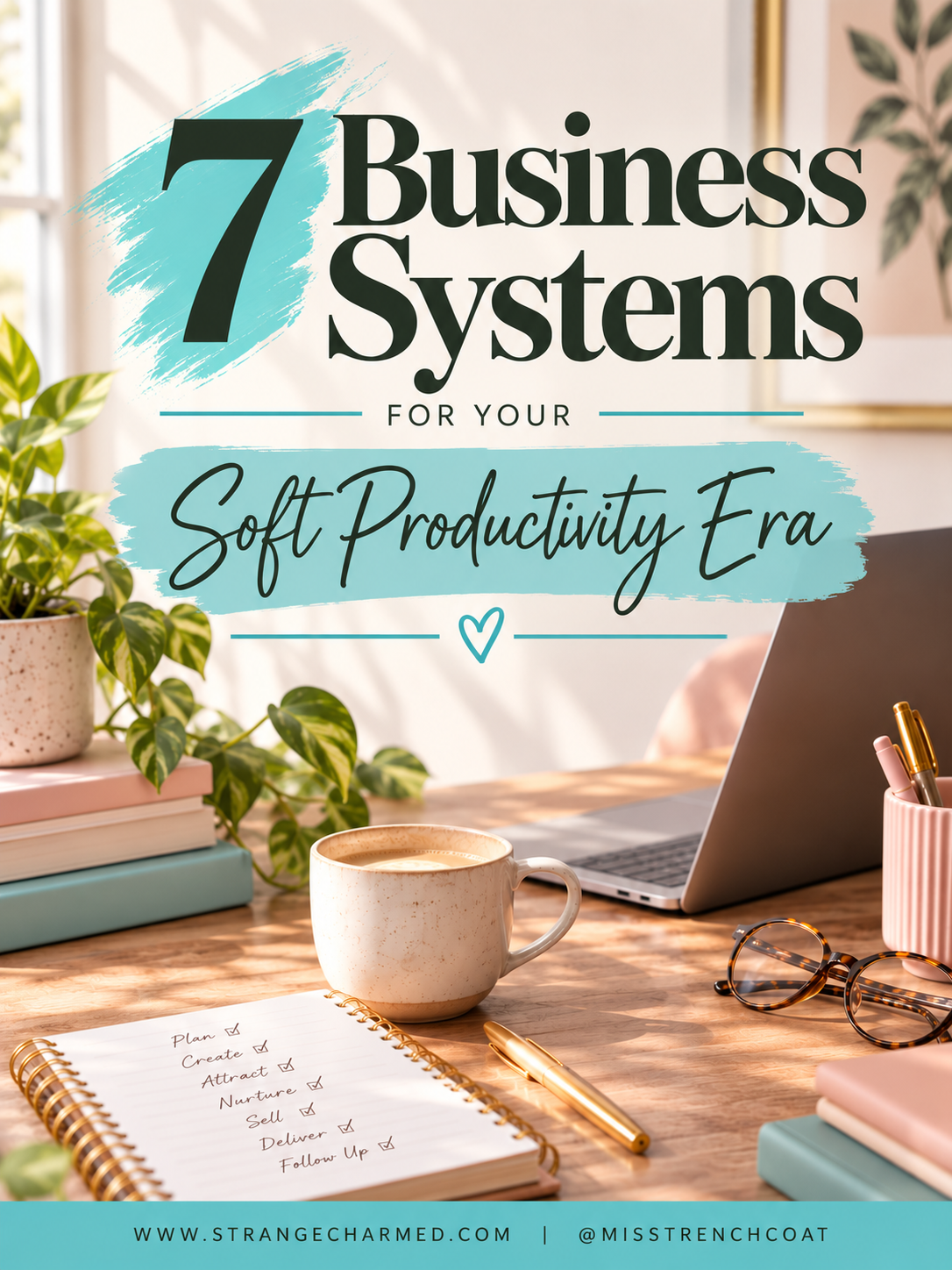
So, in this video, I want to walk you through seven business systems that I think every entrepreneur should consider building as they enter their Soft Productivity Era.
And make sure you stay with me until the end because I also have a free Soft Productivity Business Systems Checklistthat you can download to audit these seven systems in your own business and figure out which one you should focus on improving next.
Let’s get into the seven systems.
System #1: A Functional Planning System
The first system you need is a Functional Planning System.
Every business needs a reliable way to determine what actually deserves your time and attention.
Without a planning system, it’s incredibly easy to spend your working hours reacting to whatever feels most urgent in the moment.
You answer emails. You make some graphics. You tweak something on your website. You check social media. You organize some files. You complete a bunch of little tasks.
And then you get to the end of the day and think, What did I actually accomplish?
You were busy all day, but did you actually move your business forward?
A functional planning system helps you capture everything that needs your attention, identify your most important objectives, break those objectives into actionable projects and tasks, and then intentionally allocate your available time toward the work that matters most.
And this becomes especially important when your working hours are limited.
If you only have two hours to work on your business today, Soft Productivity isn’t about asking, How many tasks can I squeeze into those two hours?
It’s about asking, What are the highest-impact things I could accomplish with those two hours?
Because you don’t necessarily need more time.
You need to make sure that the work you’re giving your time to actually deserves it.
System #2: A Content Management System
The second system is a Content Management System.
Content is one of the most valuable tools you have for attracting new people to your business, demonstrating your expertise, building trust, and creating demand for your offers.
But content can also become one of the biggest drains on your time if you don’t have a system for managing it.
Without a content management system, you’re constantly starting from zero.
You open Instagram and wonder what you should post.
You sit down to write an email and have no idea what to say.
You realize another week has passed and you still haven’t published that blog post or video you intended to create.
And that creates a tremendous amount of unnecessary mental load.
Instead, you want a system that gives your ideas somewhere to live and provides a repeatable process for turning those ideas into published content.
That might include a place where you capture ideas as they occur to you, a content calendar that helps you determine what you’re going to publish, a workflow for actually creating the content, and a library where you keep track of everything you’ve already produced.
And notice that the goal here isn’t necessarily to create more content.
A good content management system may actually help you create less content because the content you do create becomes much more intentional.
You want your content connected to your larger business objectives and designed to attract the kind of people who are most likely to benefit from the offers you sell.
System #3: A Content Repurposing System
The third system is a Content Repurposing System.
And this relates to one of my favorite Soft Productivity principles for business:
Maximize before you make.
Before you assume you need to create something new, look at what you’ve already created.
If you spent hours creating a really valuable blog post, that idea doesn’t need to live and die as one blog post.
That blog post could become a YouTube video.
It could become several social media posts.
It could become an email to your list.
It could become Pinterest content.
It might even become the foundation for a future lead magnet or training.
And the same thing works in reverse. A successful video could become a blog post, an email, several short-form videos, or a series of social posts.
I’ve taught this strategy in my business content for years because creating something once and finding multiple ways to use it is one of the easiest ways to increase the return on the time you’ve already invested.
You do not need to continually feed a content machine that demands something completely new from you every single day.
Instead, you want to build a library of ideas and assets that can continue supporting your marketing.
So your content repurposing system should help you regularly look at what you’ve already created, identify what performed well, and find new ways to present those ideas to your audience.
Because just because you’ve said something before doesn’t mean everyone in your audience has seen it.
And even the people who have seen it may need to encounter the idea several times before they’re ready to act on it.
System #4: A Lead Generation System
The fourth system is your Lead Generation System.
And this is where I see a major bottleneck for a lot of small business owners.
Maybe you’re already creating content.
Maybe you have followers.
Maybe people are visiting your website, reading your blog posts, watching your videos, finding you through Pinterest or interacting with your social media content.
But then what?
What happens after someone discovers you?
Because if the answer is essentially nothing, you may be putting a tremendous amount of time and energy into attracting attention without having a reliable way to turn that attention into an ongoing relationship.
Someone can find an incredibly helpful blog post through Google, read the entire thing, close the browser tab and never come back.
Someone can watch one of your videos, think you’re fantastic, and then never have your content served to them again.
Someone can follow you on social media, but you have absolutely no control over whether the algorithm continues showing that person your content.
This is why you need a lead generation system.
Instead of hoping someone remembers you, you give them a clear next step.
Maybe that’s a checklist, workbook, template, free training, or another lead magnet that relates directly to the problem that brought them to your content in the first place.
And now, instead of that person simply consuming a piece of content and disappearing, they have a reason to join your email list and continue the relationship.
This is a really important Soft Productivity system because it allows the work you’ve already done to create a longer-term result.
Your content stops being something that simply generates views or likes.
It becomes an asset that can generate leads.
And ideally, your best evergreen content can continue doing that days, months, or even years after you originally created it.
System #5: An Email Nurture System
But generating the lead is only the beginning, which brings us to system number five: your Email Nurture System.
One of the biggest mistakes I see business owners make is putting a tremendous amount of effort into getting people onto their email list and then having absolutely no plan for what happens afterward.
Someone downloads your freebie.
They get the delivery email.
And then… nothing.
Maybe they hear from you again three weeks later when you suddenly have something you want to sell.
And by then, they might barely remember who you are or why they joined your list.
So now you’re essentially asking someone to go from, I downloaded something free from you once, to, Sure, I’m ready to give you money.
There’s an important part of the relationship missing in between.
That’s what your email nurture system is designed to address.
When someone joins your list, you can create an automated sequence that welcomes them into your world, helps them get value from the resource they requested, provides additional education around the problem they’re trying to solve, introduces your philosophy and expertise, and eventually helps them understand what their next step might be.
And the beautiful thing about this is that you create that sequence once.
Every new person who joins your list can receive that thoughtful introduction to your business without you personally recreating that experience every single time.
That is a perfect example of Soft Productivity.
You do the work once, create something valuable, and then build a system that allows that work to continue producing value.
System #6: A Sales System
The sixth system is probably one of the most important: your Sales System.
Here’s a question I want you to think about:
What causes sales to happen in your business right now?
Because if your answer is essentially, Sales happen when I actively remember to sell something, then you don’t really have a sales system.
You have a recurring task.
And this is where a lot of entrepreneurs accidentally create far more work for themselves than necessary.
They create content for a while.
Then they realize they need to make some money.
So suddenly they need to figure out what they’re going to promote.
They create a bunch of sales posts.
They send several emails.
Maybe they run a launch or promotion.
Hopefully they make some sales.
Then the promotion ends, they stop selling, and they go back to regular content until the next time they need revenue.
And then they start the entire process again.
Not only is that exhausting, but it can also make selling feel awkward because there isn’t always a natural connection between the content your audience has been consuming and the offer you suddenly want them to buy.
A Soft Productivity approach to sales asks a different question:
How can I create a natural, repeatable path that helps the right person move from discovering my business to becoming a customer?
And that path does not have to be complicated.
Someone discovers a piece of useful content because it addresses a problem they’re experiencing.
That content introduces them to a relevant free resource.
They join your email list to receive the resource.
An email sequence provides additional education, builds trust, and helps them better understand the problem.
And eventually, you introduce a paid offer that helps them solve that problem more completely.
So you have:
Content. Lead magnet. Email. Offer.
That is the foundation of a simple sales funnel.
And I want to emphasize the word simple, because I think people sometimes hear the term “sales funnel” and imagine some massive, complicated marketing machine.
It doesn’t have to be that.
At its core, a sales funnel is simply an intentional path that connects the work you’re already doing.
Your content attracts the right people.
Your lead magnet turns some of those people into leads.
Your emails build the relationship.
And your offer gives them an opportunity to take the next step with you.
That means your sales no longer have to depend entirely on constant posting, repeated launches, or you manually remembering to promote your products every day.
You can still launch. You can still run promotions. You can absolutely still actively sell.
But those things don’t have to do all of the heavy lifting.
System #7: A Customer Follow-Up System
And finally, system number seven is a Customer Follow-Up System.
Your existing customers are one of the most valuable resources in your business, but a lot of entrepreneurs spend significantly more time thinking about how to find new customers than they do thinking about the people who have already purchased from them.
So ask yourself:
What happens after somebody buys?
Do they receive guidance that helps them actually use what they purchased?
Do you check in with them after an appropriate amount of time?
Do you ask for feedback?
Do you give happy customers an easy way to provide a testimonial?
And is there another product or service you offer that could logically help them with their next step?
A simple customer follow-up system can help you strengthen those relationships while also creating opportunities for additional sales, referrals, reviews, and testimonials.
And again, the Soft Productivity approach is to create a repeatable system rather than relying on yourself to remember every individual action.
Enter Your Soft Productivity Business Era
So those are the seven systems I want you to think about:
Your Functional Planning System.
Your Content Management System.
Your Content Repurposing System.
Your Lead Generation System.
Your Email Nurture System.
Your Sales System.
And your Customer Follow-Up System.
Now, I don’t want you to finish this video thinking, Great. Alexis just gave me seven enormous projects I need to complete.
Please don’t do that.
That would be the exact opposite of what we’re talking about.
You do not need seven perfect systems by next week.
Instead, I want you to ask yourself:
Which part of my business currently requires more of my time and attention than it should?
Where are you repeatedly doing the same work?
Where does everything stop moving whenever you stop actively working?
And where would creating a little more structure now save you a significant amount of time and energy later?
Maybe you constantly struggle to decide what to work on, so you need to strengthen your planning system.
Maybe content creation is taking over your life, so you need better content management and repurposing systems.
But if you’re already creating content and it isn’t consistently generating leads, if people are joining your email list but there isn’t a clear journey waiting for them afterward, or if sales tend to happen only when you’re actively launching and promoting, I would pay particularly close attention to your lead generation, email nurture, and sales systems.
Because those three systems work together.
They allow you to take the attention you’re already generating and create a path that can turn some of those people into leads, nurture those leads over time, and eventually introduce them to an offer that can help them.
And that can remove an enormous amount of pressure from the way you market and sell your business.
Download the Soft Productivity Business Systems Checklist

Now, if you want some help figuring out which of these systems you should focus on next, I created a free Soft Productivity Business Systems Checklist to go along with this video.
It’s not just a list of the seven systems.
I’ve broken each one down into specific elements so you can actually audit your business, see what you already have in place, identify where the gaps are, and determine which system would create the greatest improvement for you right now.
And remember, the goal isn’t to check every box immediately.
The goal is to find your next system.
So use the link below to download your free copy of the Soft Productivity Business Systems Checklist, go through the audit, and use it to identify the next system you can simplify, strengthen, or put to work in your business.
Because Soft Productivity isn’t about wanting less from your business.
It’s about building your business in a way that doesn’t require more and more from you in order to grow.
xoxo,